Research
I have participated in research projects with biophysics labs, solid state physics labs, and oncology labs ranging across experiment, computation and theory. It is clear that I have been an itinerant researcher, but the diversity of projects have all served to interegate basic physical theory.
Previous Projects
Second-Order Effects on Cancer Treatment Efficacy
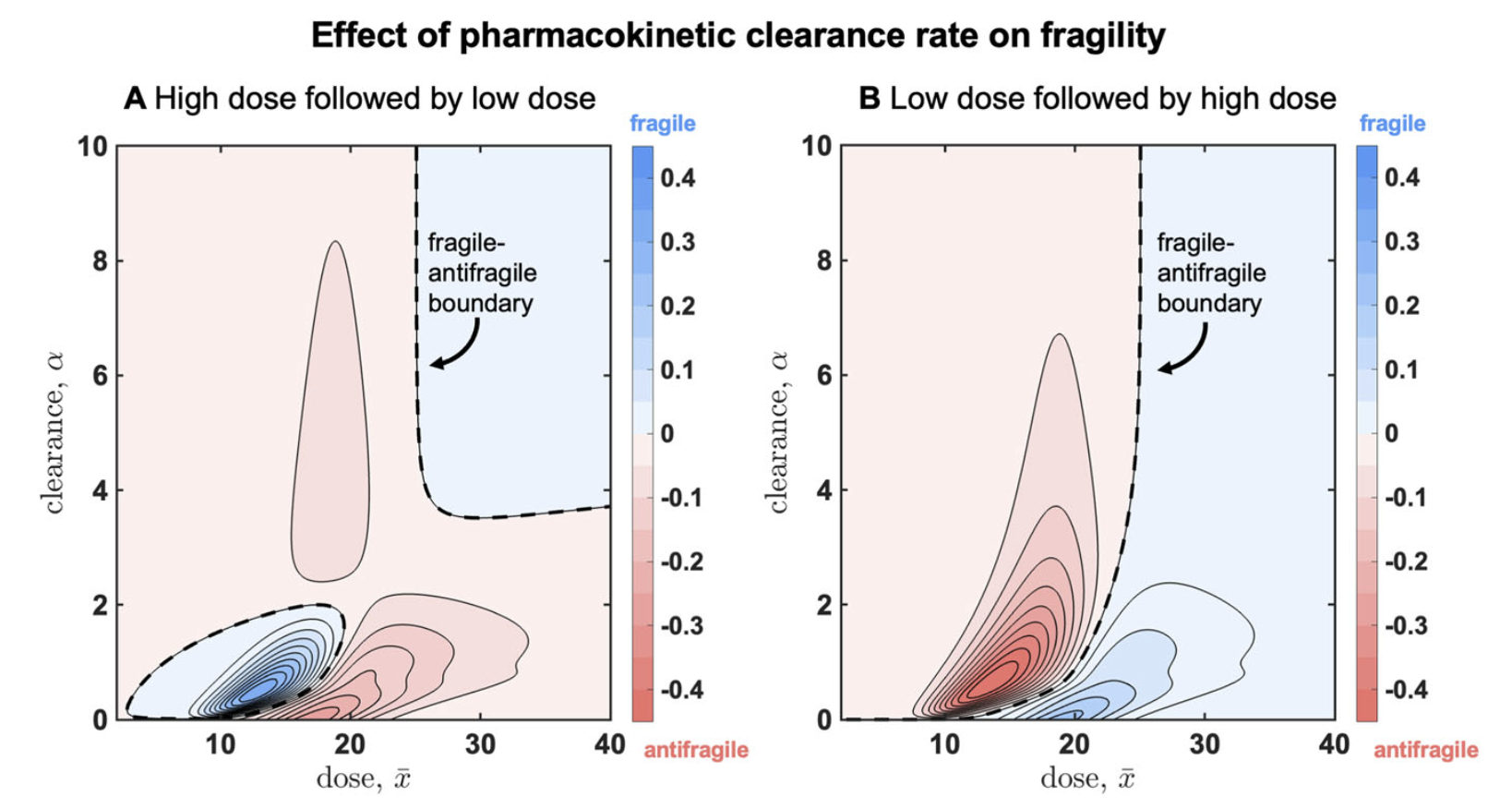
Until 2025, my research focus had been in mathematical biology, specifically oncology and population dynamics, and in Spring 2024, I published my first paper alongside my mentor Jeffrey West at the Moffitt Cancer Center in Tampa, Florida. Here we completed some analysis and simulations for different deterministic models of cancer proliferation and repression to determine when a tumor will respond positively (or negatively) to increased treatment variability. We characterized the benefit gained from treatment variability through a so-called “fragility metric” and found that higher treatment variability benefited smaller tumors and lean mass preservation. This result contributes to a growing body of literature challenging the standard-of-care procedure that uniformly delivers a maximum tolerated drug dose to cancer patients, and instead promotes new, individualized therapies which treat a patient’s unique disease profile.
Evolutionary Coexistence Among Hawaiian Crickets
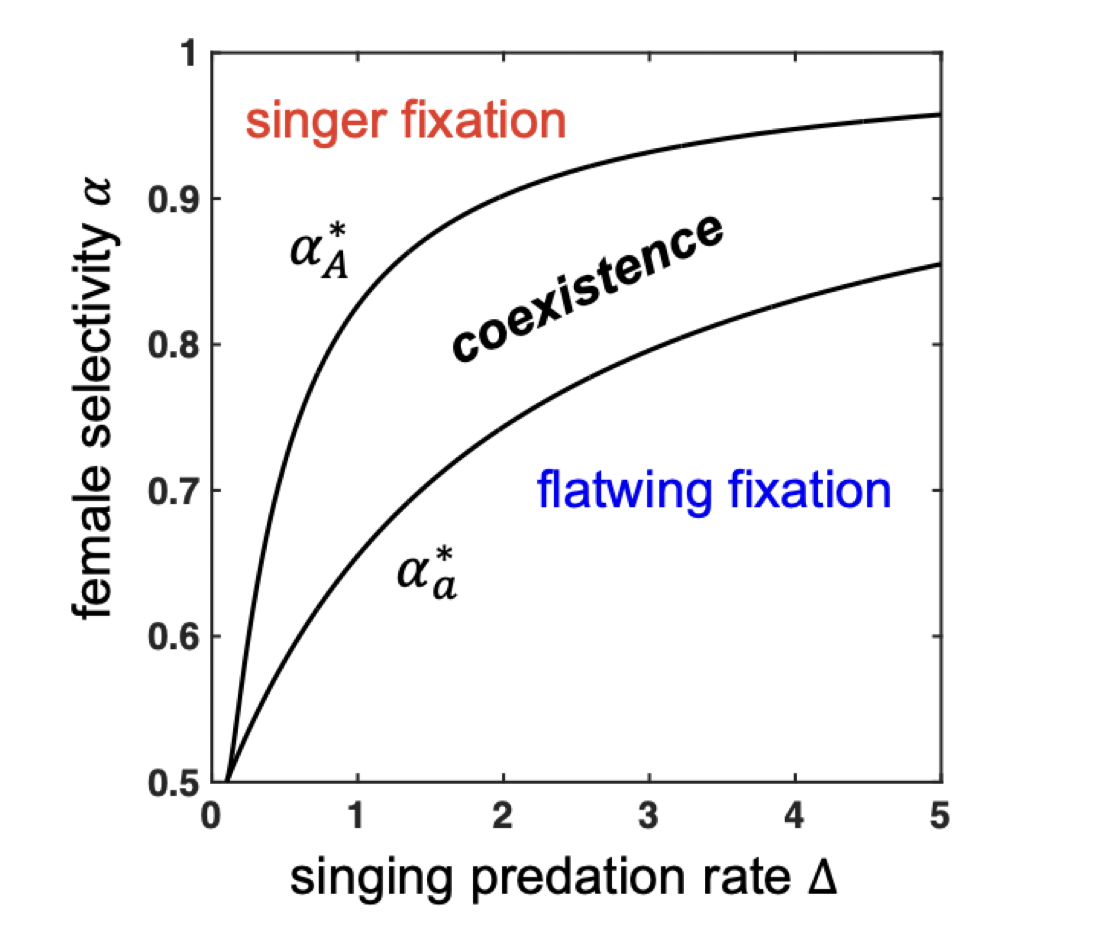
In September 2023, I completed my Master’s Thesis at the University of St Andrews under the supervision of Alexander Stewart. This unpublished work considers a modern example of convergent evolution on the Hawaiian islands where field crickets (Teleogryllus oceanicus) adopt a “flatwing” mutation, which inhibits the ability for male flies to attract females, but has the advantage of evading predation by local flies. Despite extensive measurements of local cricket populations, no rigorous investigation of the tradeoffs between female attraction and fly evasion existed. This work developed a novel ecological-genetic model that predicts conditions for the mutant and non-mutant crickets to coexist with the flies given certain basic parameters. This model therefore hypothesizes bounds on biological parameters within the Hawaiian cricket-fly system and offers a means to explore other enviroments where cricket-fly coexistence is possible.